✦
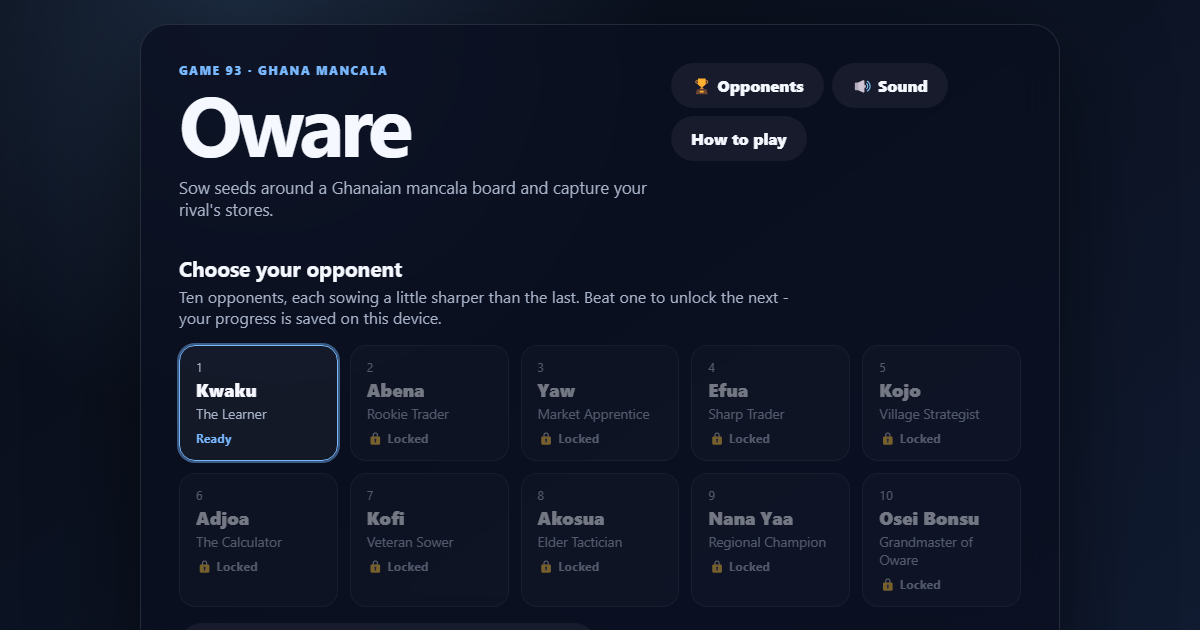
Opponent ladder
Numbered opponents with increasing strength, saved locally as you beat each one.
Help improve VibWebs
With your permission, we use Google Analytics to understand which pages and game features are useful, and allow Google to personalize the ads that help keep these games free. You can change this choice in Privacy.
Sow seeds around a real mancala board, capture your rival’s stores, and climb a ladder of tougher AI opponents.
Follow these simple steps to master the game mechanics and clear every tier.
Choose an opponent from the difficulty ladder, then pick one of your six pits to sow its seeds counterclockwise, one per pit.
Land your last seed in an opponent pit that then holds 2 or 3 seeds to capture it — captures chain backward through consecutive qualifying pits.
The game ends when a side can no longer be fed; remaining board seeds go to whichever side still has seeds. Capture the most seeds to win.
Master the ancient Ghanaian national game of calculation, foresight, and harvest.
Oware is a two-row mancala sowing game originating in West Africa and celebrated as the national board game of Ghana. The name Oware stems from the Akan phrase "Oware" (meaning "he/she marries"), rooted in a legendary story of a man and woman who played the game continuously and married to prolong their contest.
Historically cherished by royalty in the Ashanti Kingdom, intricate Oware boards carved from mahogany and embellished with royal crests were used to settle disputes, sharpen mathematical calculation, and entertain diplomatic visitors.
Today, Oware is standardized internationally under the International Oware Federation and is renowned for its zero-luck, purely deterministic state space.
The board consists of two parallel rows of 6 pits (houses), giving 12 pits in total, with 4 seeds (traditionally bonduc seeds or pebbles) placed in each pit at the start (48 seeds total).
On their turn, a player chooses one of the six pits on their side of the board, picks up all seeds contained within it, and sows them one by one in a counterclockwise direction into consecutive pits.
If a sown pit contained 12 or more seeds, the starting pit is skipped during the lap (a house cannot sow a seed into itself on the same turn).
A capture occurs when the final seed of a sowing lap lands in an opponent’s pit, bringing the total seed count of that pit to exactly 2 or 3 seeds.
If the preceding pit in the opponent’s row also contains 2 or 3 seeds, those are captured as well, chaining backward continuously until reaching a pit that does not have 2 or 3 seeds or leaving the opponent’s territory.
A player is never permitted to deliberately starve their opponent of moves. If the opponent’s row is completely empty, the active player must make a move that sows seeds into the opponent’s side if legally possible.
Grand Slam Rule: If a move would capture ALL seeds on the opponent’s side leaving them with zero legal moves, no seeds are captured—they remain on the board so the opponent can continue playing.
Accumulating 12 or more seeds in a single pit creates a "Kroo" lap that circumnavigates the entire board. When released at the right tactical moment, a Kroo can disrupt opponent defensive structures and seed multiple opponent pits for consecutive multi-pit captures.
Keep vulnerable pits at 0, 1, or 4+ seeds. Pits with 1 seed are dangerous because an opponent dropping a single seed turns them into a 2-seed capture target. Always maintain awareness of opponent sowing ranges.
Oware is a full rule-based mancala engine — real sowing, wraparound, and chained captures — played against a heuristic AI that gets tougher as you climb the ladder.
Numbered opponents with increasing strength, saved locally as you beat each one.
Counterclockwise sowing with proper wraparound and backward-chaining captures.
A real implementation of Ghana’s classic mancala tradition, not a generic board reskin.
Embed this game
Add Oware to your own site or blog with this code.
Oware is a traditional Ghanaian mancala game. You sow seeds counterclockwise around a circle of pits and try to capture your opponent’s seeds.
Landing your last sown seed in an opponent pit that then holds 2 or 3 seeds captures it, and the capture chains backward through consecutive qualifying opponent pits.
The game ends when one side can no longer be fed seeds. Any seeds remaining on the board go to whichever side still has seeds, and the highest seed count wins.